Reflections of a Non-Gamer. Multiplatform 2026: Poetry in Games / Games in Poetry
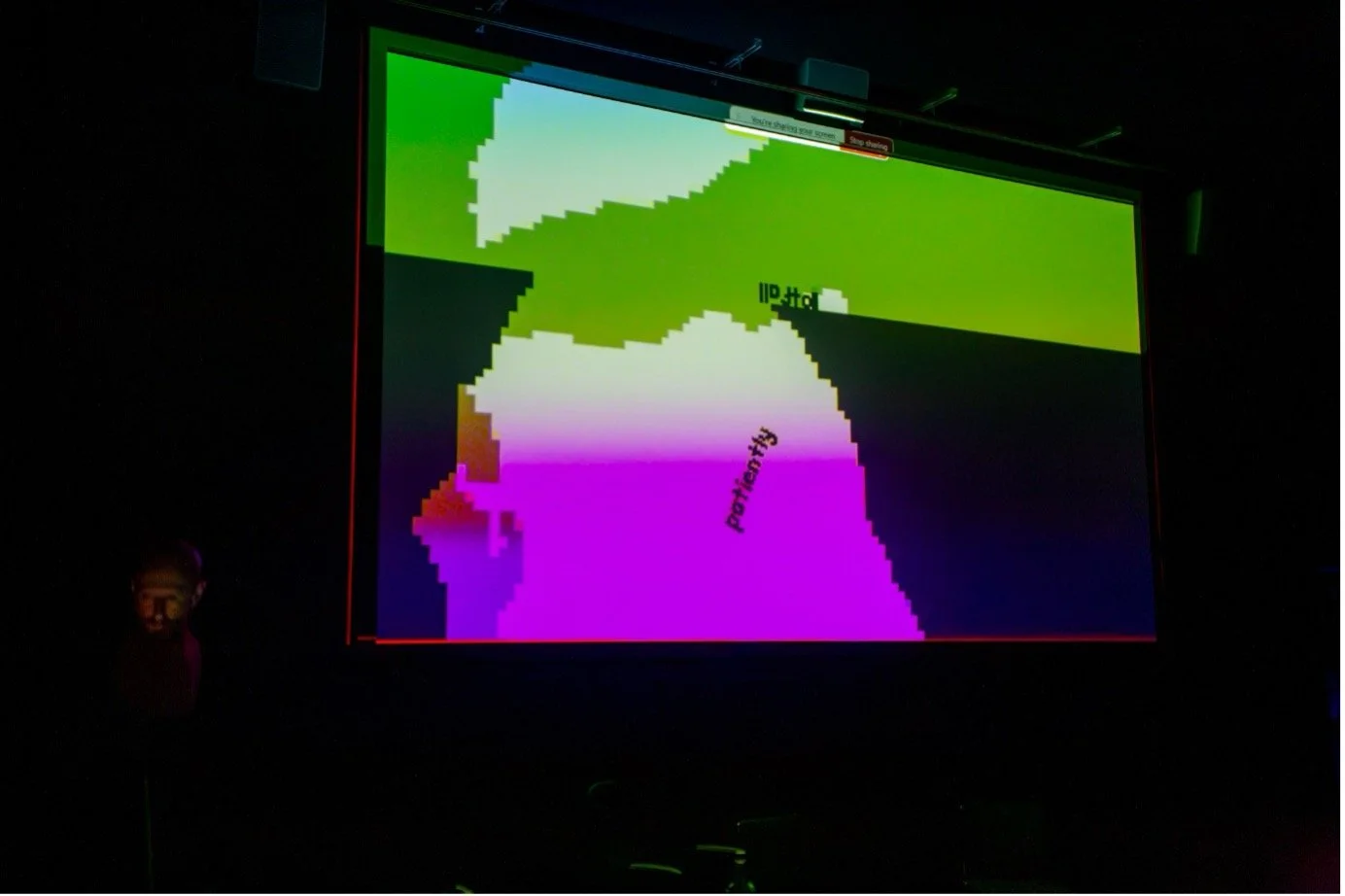
From After Rilke: A Game Poem Diptych by Jordan Magnuson (Photo: John Greenwood)
Post by Martin Kratz, Manchester Poetry Library
The plumber turns invincible as a firewalker.
A chance to extricate oneself. How often
have our lives known that brief
immunity – the crisis which emits
a stretch of ardent unreflective life?
(from ‘Mercy Invincibility’ by Vidyan Ravinthiran)
Here (belatedly) is the introduction I was going to give to the panel I chaired on ‘Translation, Constraint, and the Adapted Form’ for Multiplatform 2026: Poetry in Games / Games in Poetry. I didn’t give it in this form then, because Dr Jon Stone’s keynote on labyrinths got into my head. But I wanted to begin this piece, as I’d intended the panel, with the poem I quoted above.
‘Mercy Invincibility’ by Vidyan Ravinthiran is the poem that first got me thinking about poetry and video games. It’s not obvious because Ravinthiran frames his sonnet as a universal experience (and maybe it is too), but in an interview, he explains that (among other things) it was written in the aftermath of a verbal racist attack. For me, what I saw here was a line drawn between poem, game, and embodiment. It was not simply that the game was a worthy subject of poetic consideration, but that it allowed for a new way of thinking. It is also a poem about partnership and being with others.
This constellation was in some way unpacked or touched upon throughout Multiplatform 2026. It might be the involvement of the body through rhythm/timing, the nod to the fluidity of parkour in Mirror’s Edge: Catalyst’s gameplay, or the body of the game /poem itself manifested through formal restraint. It was there in the very fabric games were made of, from pixel to patchwork.
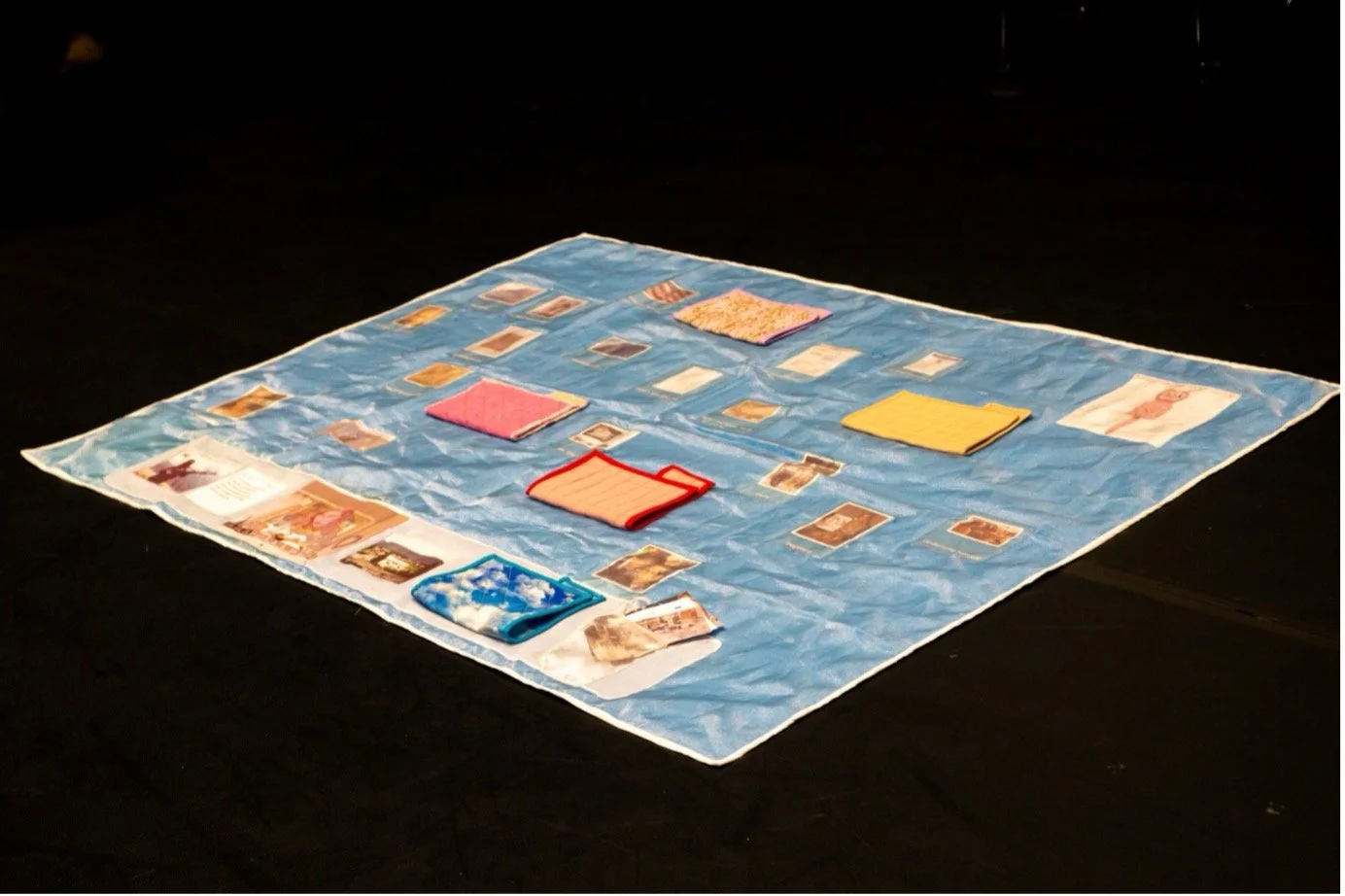
Party in the front, disaster in the back: a fucking didactic textile archive by Mailey Horner & Jonathan Carroll (Photo: John Greenwood)
It is also evidenced by the photographs taken by John Greenwood. The first thing I noticed going through them was the images of people on their phones. This is not the image I have in front of me now, writing on the train, where everyone is on their phone alone (though I see one person who isn’t). These are photographs of people constantly showing each other (and me) new things – a constant sharing.
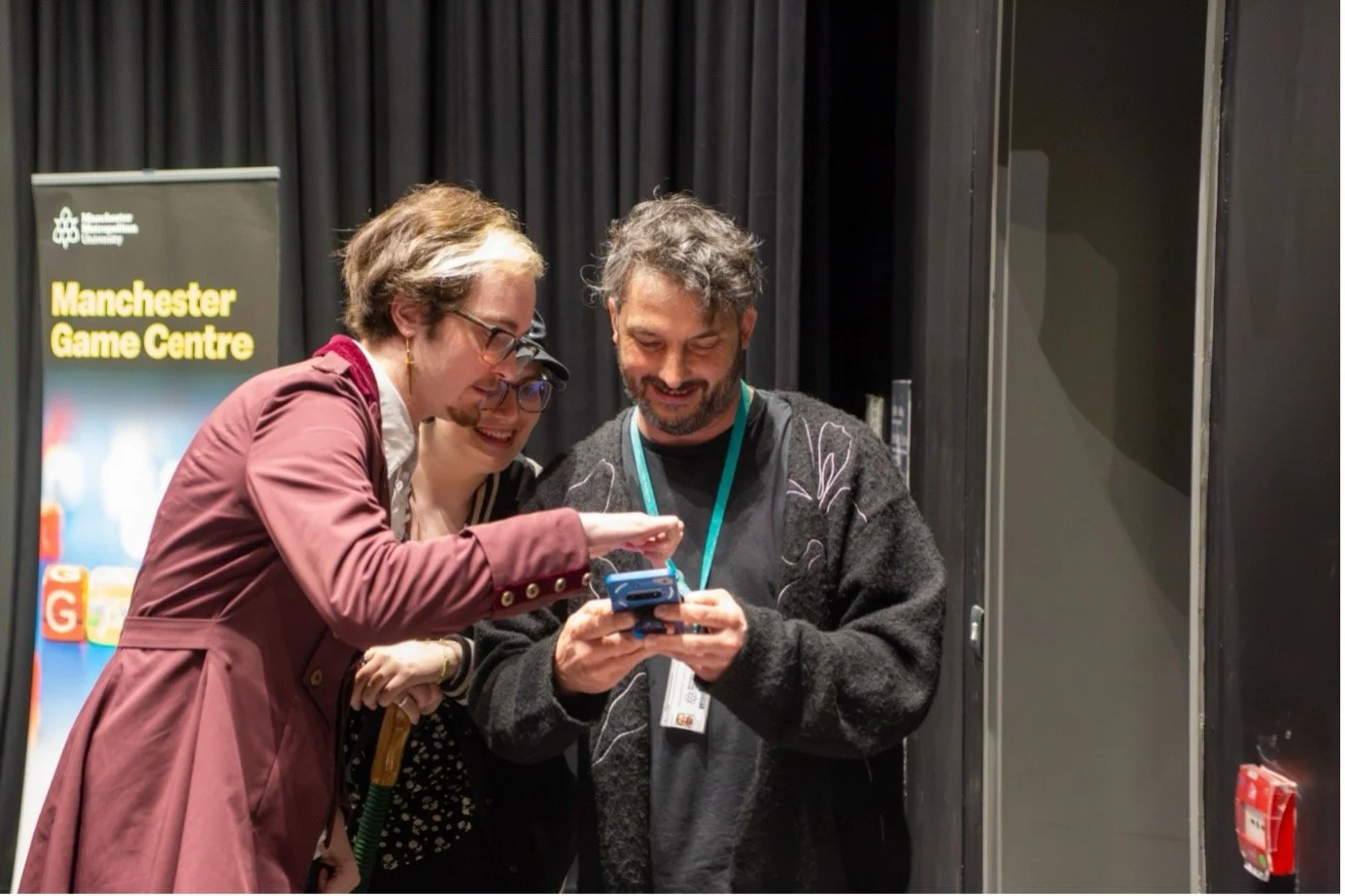
Photo: John Greenwood
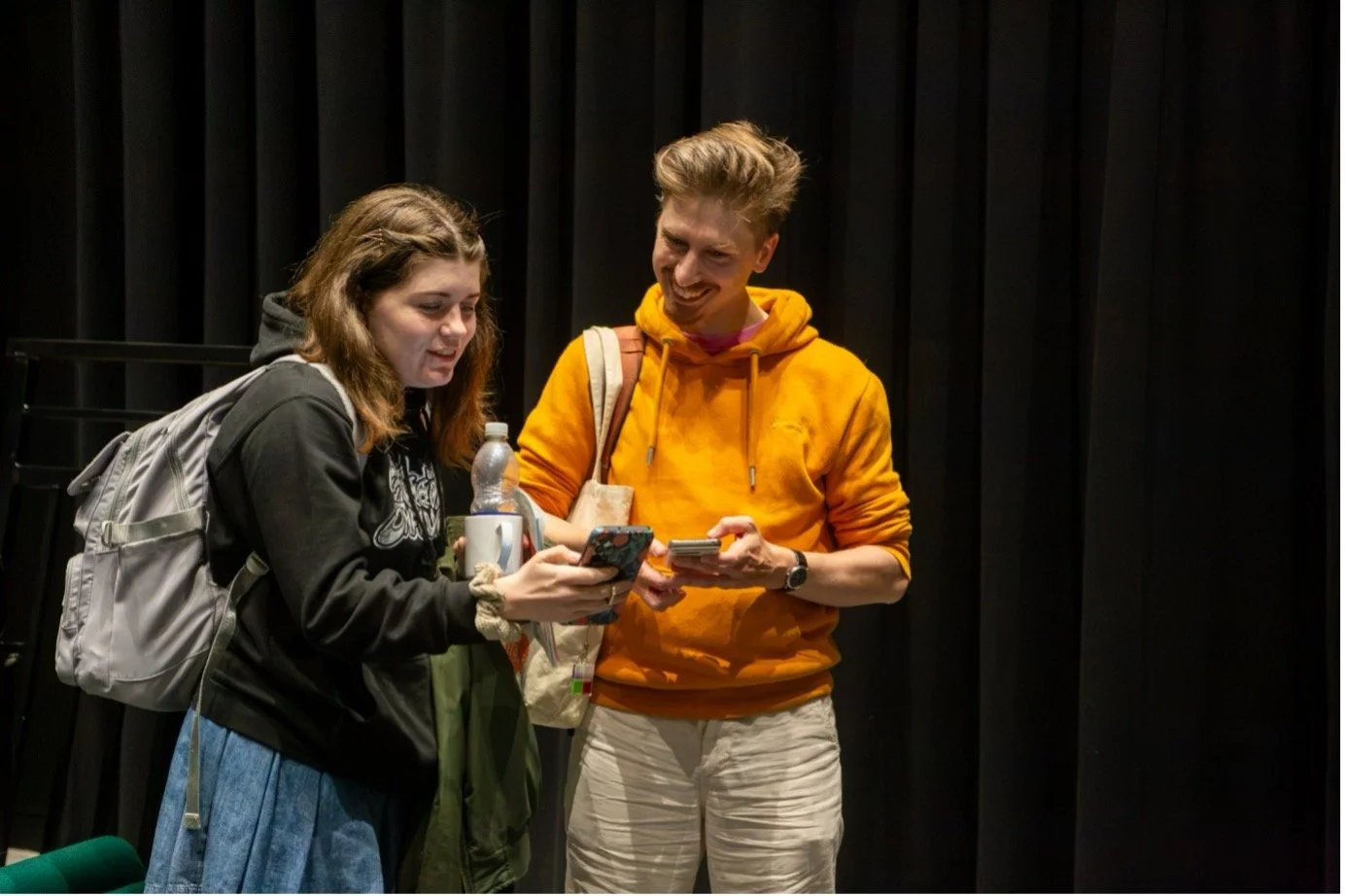
Photo: John Greenwood
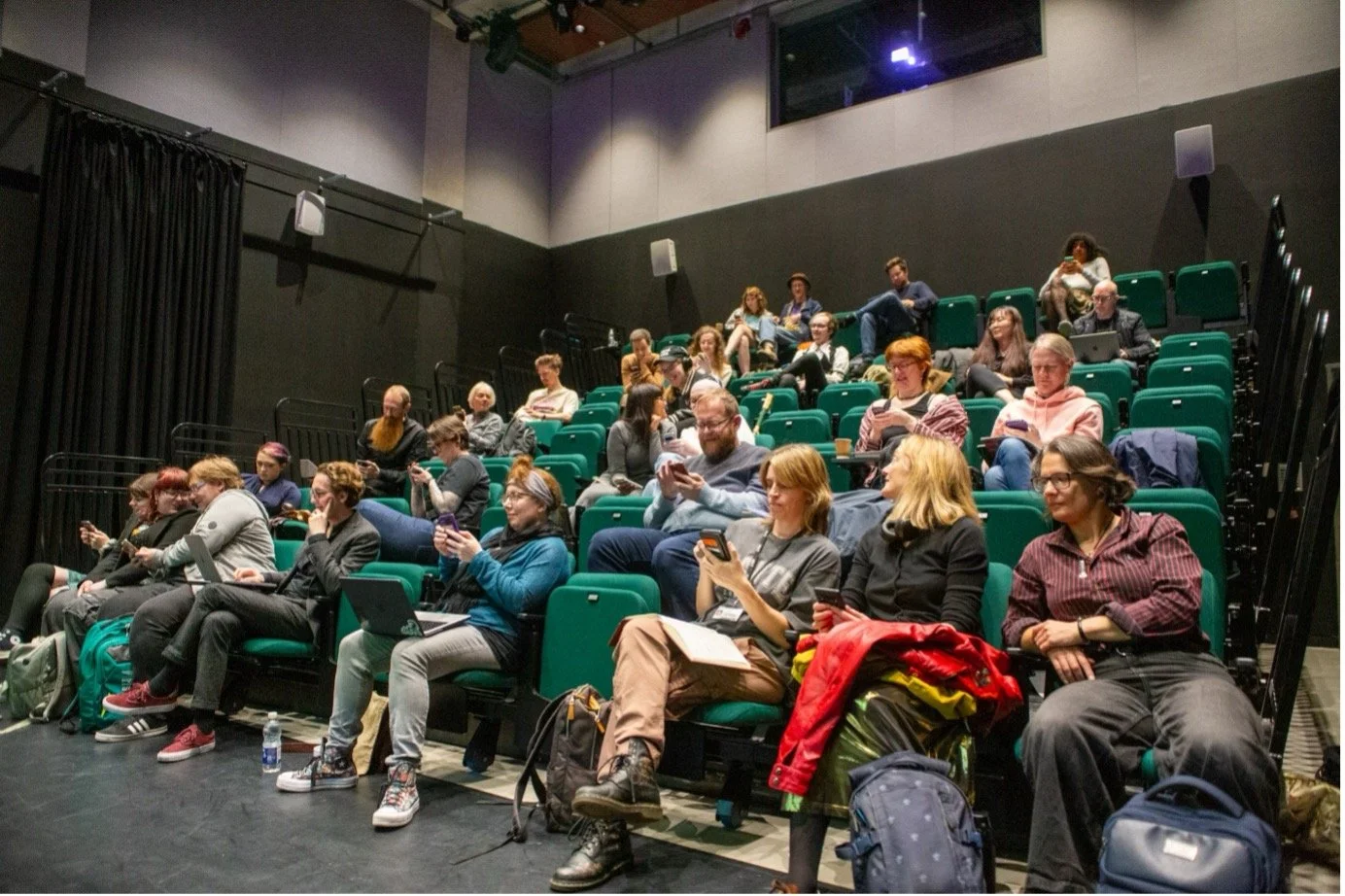
Photo: John Greenwood
I thought of myself as very much the outsider at this conference. While I enjoy games, I have also found the world of games intimidating. Growing up, video games seemed to be so much about skills and abilities – and later a language – which I didn’t have. But people feel like this about poetry too.
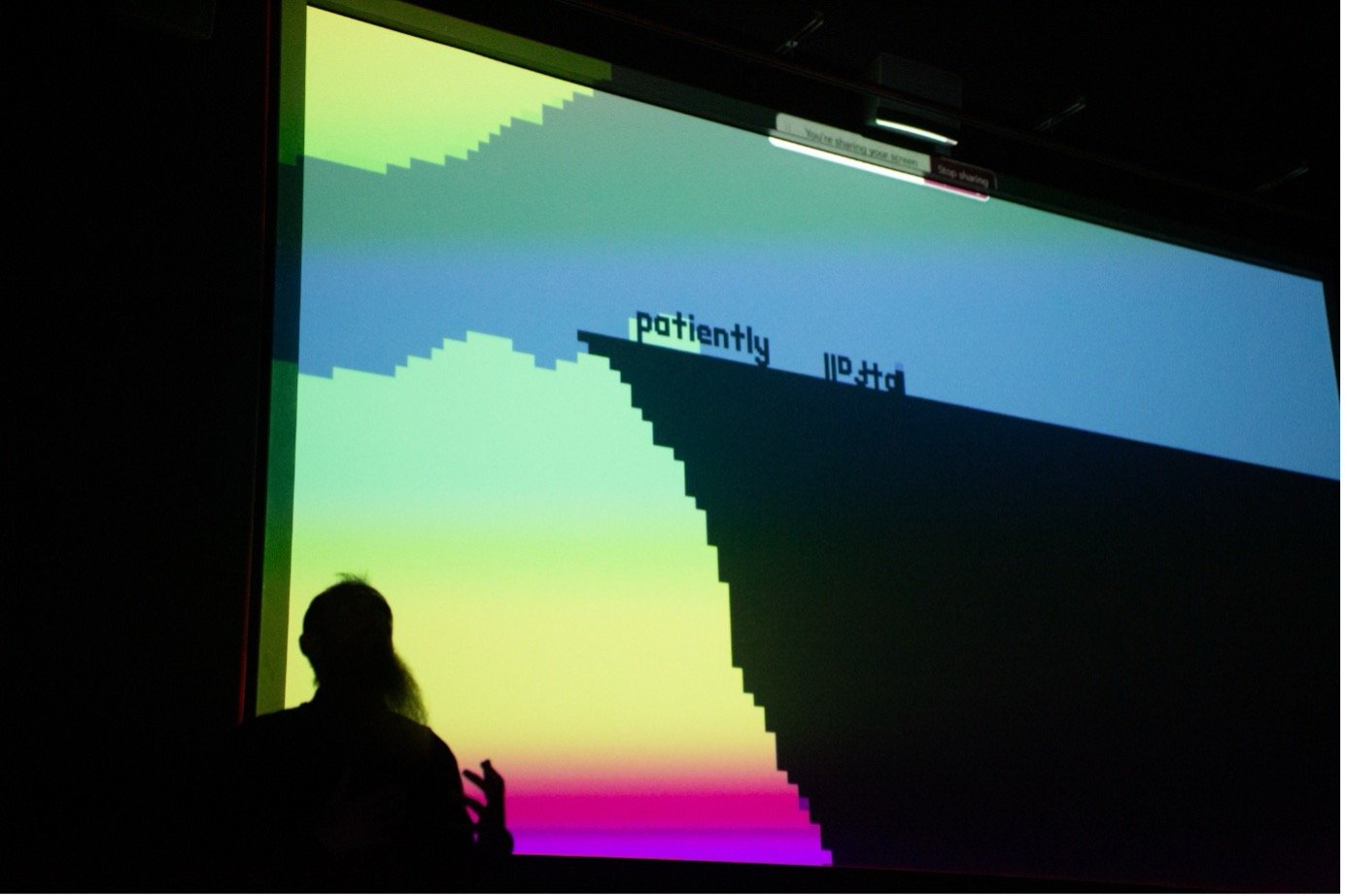
From After Rilke: A Game Poem Diptych by Jordan Magnuson (Photo: John Greenwood)
The game poem, then, has been a particular revelation, as it doesn’t necessarily require any of these things to play, enjoy or even – as Jordan Magnuson would have it – to write. (In his presentation and others, you also had the poem as a worthy subject for the game – turning my original bias on its head.)
I was fascinated by the photos of the Poetry Game Jam. Is this what you would see if you photographed a creative writing workshop? Y/N. Maybe.
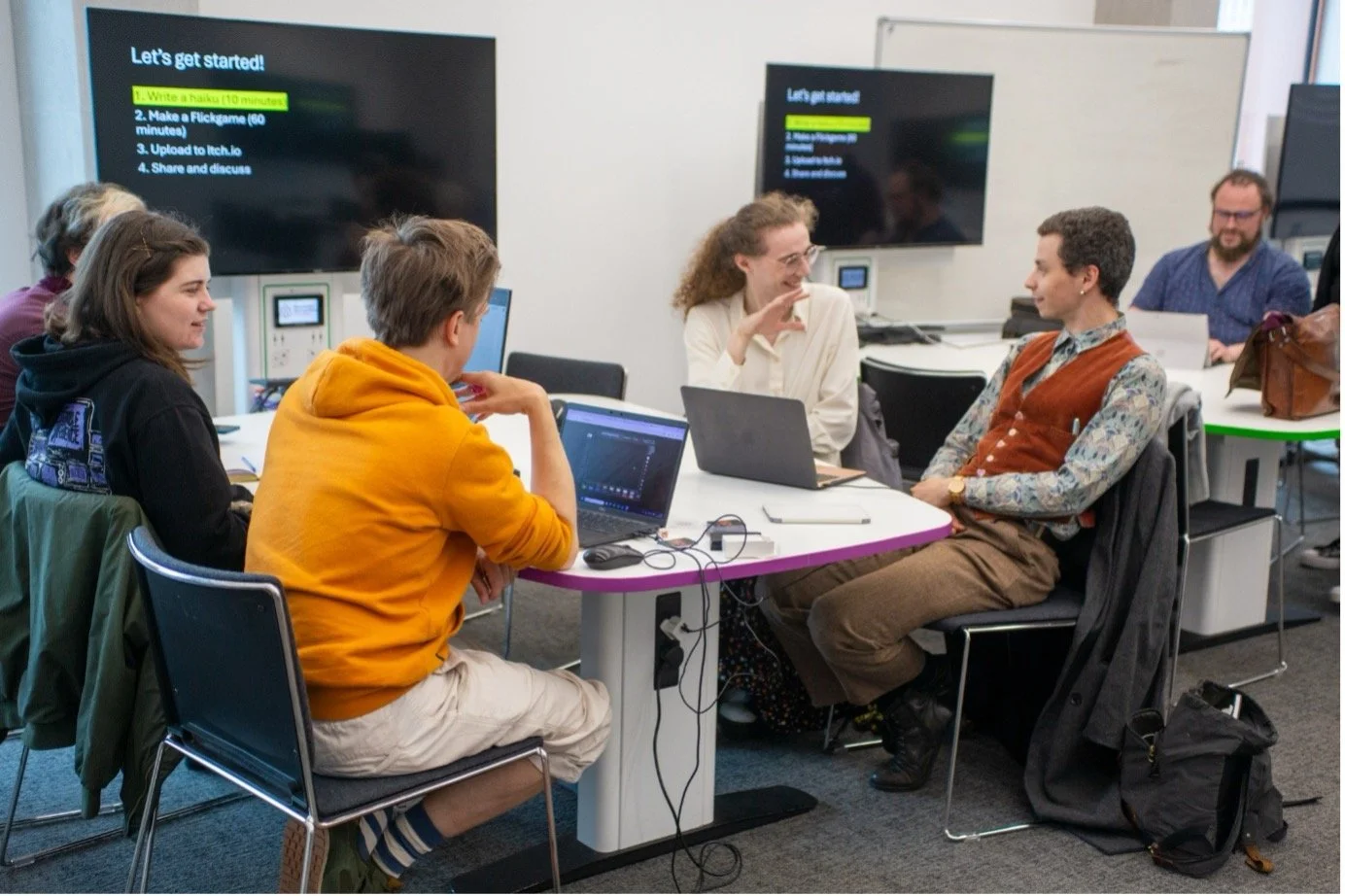
Poetry Game Jam with Jordan Magnuson (Photo: John Greenwood)
Writing workshops too can be full of laughter and play, but maybe something else happens when that sense of play is foregrounded in this way.
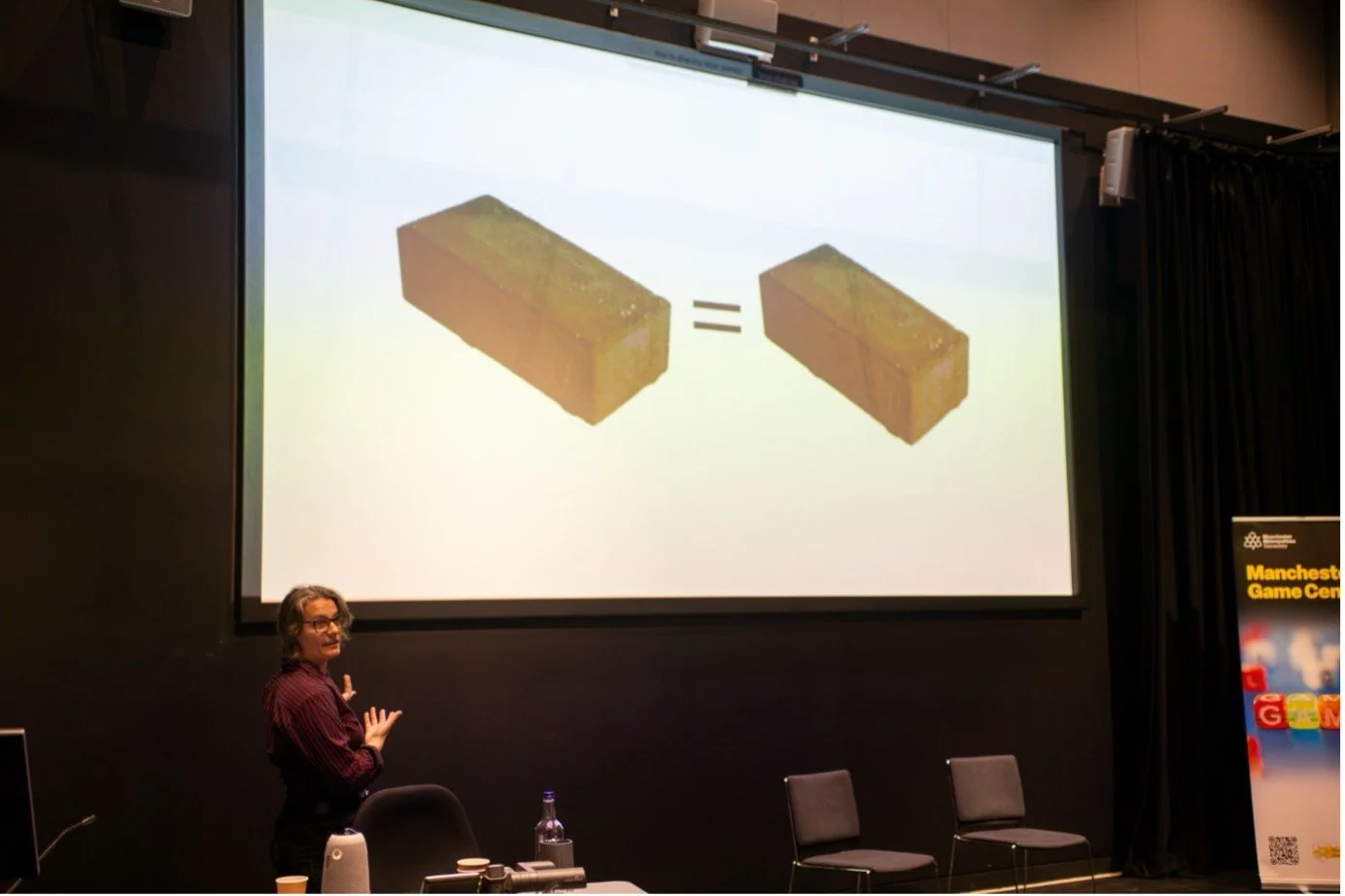
Trivial Pursuits: What do we mean by playful? by Dr Abigail Parry (Photo: John Greenwood)
I want to extend a huge thank you to all the speakers and attendees; to the organisers, Reuben Martens and Jenny Cromwell, and to John, who is behind the camera on all of these. As the Programme Manager at Manchester Poetry Library, one thing I hoped to get thoughts on was what collecting, accessioning, and offering access to poetry/games might look like in the poetry library. I requested answers on postcards, but you can also email me at M.Kratz@mmu.ac.uk. But we begin to get the sense of a beginning from the below…
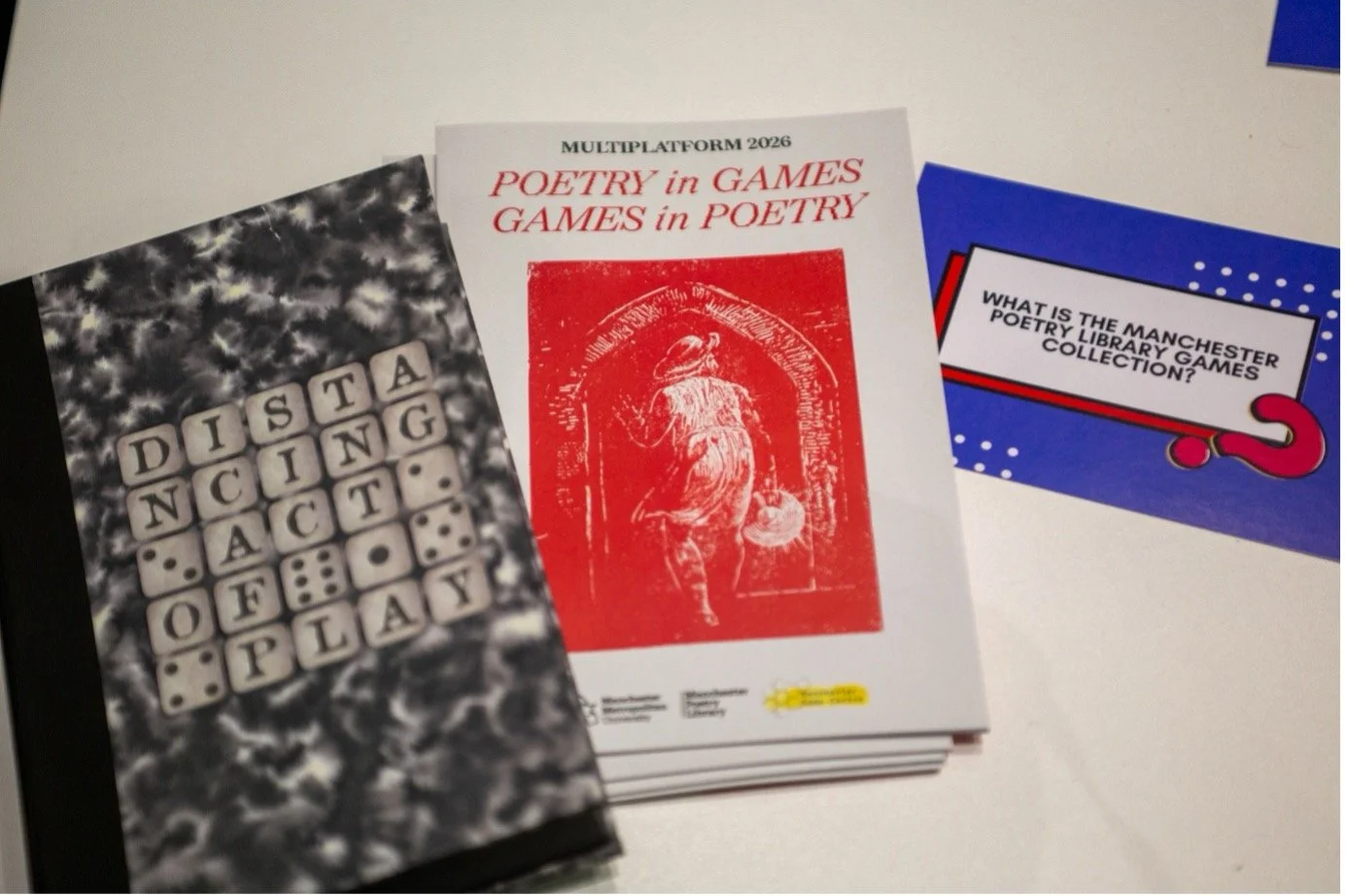
Photo: John Greenwood
Multiplatform: A Reading List
Over the course of the conference, John Greenwood made note of as many of the works and authors mentioned as possible. You can check them out below. Where we have specific books in the Poetry Library, the self-location has been added in square brackets. We have linked to individual poems where we have found them online.
Poets included…
Lucy A. Armstrong, Charles Baudelaire, Greg Bem, William Blake, Ivan Blatný, Christian Bök, Charlotte Brontë, Emily Brontë, Anne Brontë, Charles Bukowski, Lord Byron, Richard A. Carter, J.W. Curry, Shastra Deo, T.S. Eliot, Robert Frost, Liam Gibbons, Terrance Hayes, Eugene Jolas, Ilya Kaminsky, Alyse Knorr, Andrew McMillan, Stephen Mooney, Pablo Neruda, Yoko Ono, Abigail Parry, Ezra Pound, Rose Ramsden, Anton Romanenko, Aram Saroyan, Atreyee Sen, Samuel Mui Soon, Sandy Wardrop, Harrison Whitaker, Walt Whitman, William Wordsworth.
Poems included…
'The Dawn Breach' (from Fragments from the Vault) by Lucy A. Armstrong, 'The Labyrinth' by W. H. Auden, 'The Marriage of Heaven and Hell' by William Blake, 'If This Be All' by Anne Brontë, 'Hope' by Emily Brontë, 'The Crunch' by Charles Bukowski, 'Darmstadt Lecture' by John Cage, 'Variations on the Word Ghost' by Shastra Deo, 'The Hollow Men' by T.S. Eliot, 'Ars Poetica with Desire Line' by Ella Frears, 'Brevity' by Liam Gibbons, 'Theatre Night' by Ilya Kaminsky, 'Provocação' (The Tooth Labyrinth) by Alberto Pimenta, 'In a Station of the Metro' by Ezra Pound, ‘Mercy Invincibility’ by Vidyan Ravinthiran, 'Lighght'by Aram Saroyan
Poetry books/collections included…
Poems of the Brontë Sisters by Charlotte, Emily, and Anne Brontë [821.008 BRO], Adventures in Form: A Compendium of Poetic Forms, Rules & Constraints by Tom Chivers (ed.) [821.9208 ADV], The Exclusion Zone by Shastra Deo [821.92 DEO], The Poetry of Robert Frost by Robert Frost [811.52 FRO], Deaf Republic by Ilya Kaminsky [841.6 KAM], Game Poems: Videogame Design as Lyric Practice by Jordan Magnuson, The Essential Neruda by Pablo Neruda [861.62 NER], I Think We're Alone Now by Abigail Parry [821.92 PAR], Jinx by Abigail Parry [821.92 PAR], Poems by Rainer Maria Rilke [831.912 RIL], If All the World and Love Were Young by Stephen Sexton [821.92 SEX], Dual Wield: The Interplay of Poetry and Video Games by Jon Stone, Leaves of Grass by Walt Whitman.