Beyond Tutorials: Designing for Relational Agency in Informal Game Development Education
Post by Mick Chesterman
This post is in part a celebration of my recently completed PhD, Pump up the Jam: Facilitating Participant Collaboration and Agency in Creating Code-Based Retro Games, and more importantly an opportunity to share two of the research outputs most relevant to the Manchester Game Centre. The thesis explored how game making can be designed as an inclusive, collaborative learning activity through five iterative cycles of design-based research with home-educating families over several years. One outcome of this work was an emerging pedagogy for supporting collaborative game making. By pedagogy here, I mean the design of learning experiences: the ways activities, tools, relationships and environments are intentionally organised to support learning.
In this post, I introduce the REEPPP (Remix-Enabled, Elective, Progressive, Pattern-Patching) pedagogy that emerged from the research and, within it, the role of a growing collection of practical resources, particularly a co-created collection of Gameplay Design Patterns (GDPs), which became shared mediating artefacts carrying knowledge and practices between participants, facilitators and successive workshops.
The multiple elements of the REEPPP framework reflect a deliberately messy learning environment with many moving parts. Working with home-educating families, I came to appreciate this complexity and found myself increasingly at home within it. Before explaining the framework itself, it is worth asking how I became interested in this kind of deliberately messy pedagogy in the first place. My interest in these kinds of pedagogies actually pre-dated the PhD. Much of my work had taken place in informal learning spaces and community projects where participation was open-ended, collaborative and often appeared chaotic. I came to think of these as sketchy learning environments: deliberately unfinished spaces that invited people to contribute, adapt and reshape what was happening rather than follow a singular process of instructions.
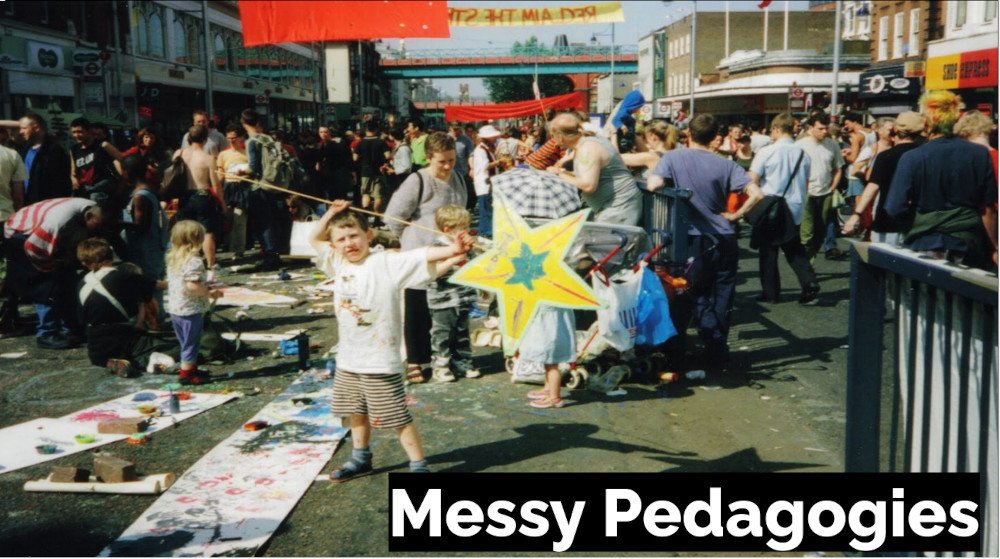
The PhD helped me to explore the value and underlying processes within this apparent messiness. Looking more closely at relationships, interactions, and shared practices, I found that what first appeared chaotic revealed underlying patterns of collaboration and mutual support.
A quick note on theory: I don’t want to get too distracted by the theoretical foundations here, but REEPPP draws heavily on sociocultural theory. Barbara Rogoff’s work on different dimensions of participation provided an important turning point. If you’re interested in exploring that background, Barbara Rogoff’s work on Learning by Observing and Pitching In (LOPI) is an excellent place to start, and the LOPI project website provides a very accessible introduction.
Later in my research, I realised that these learning environments had much in common with a musical jam session. From the outside they could appear unstructured, but closer observation revealed shared repertoires, implicit rules and participants constantly responding to one another. The pedagogy that emerged from the research supported this kind of productive improvisation by providing structure through responsive resources, relationships and shared practices.
Gameplay Design Patterns as an organising resource
One of the principal pedagogical contributions of the PhD was the development of Gameplay Design Patterns (GDPs) as a shared organising resource for game development learning.
Gameplay Design Patterns are recurring gameplay ideas, such as collecting objects, health systems, scrolling worlds, projectiles or timers, that can be recognised across many different games. Rather than introducing programming through language features or isolated coding exercises, participants explored these familiar gameplay concepts as reusable design ideas that could be adapted, combined and extended within their own projects.
Each pattern combined a familiar gameplay feature with concrete code examples and implementation ideas. This allowed participants to move naturally between higher-level design thinking and the practical work of programming, while building a shared language for discussing games and their underlying mechanics.
Rather than being organised as a sequence of tutorials, the patterns formed a growing menu of gameplay features that learners could browse, remix, and combine according to their own interests.
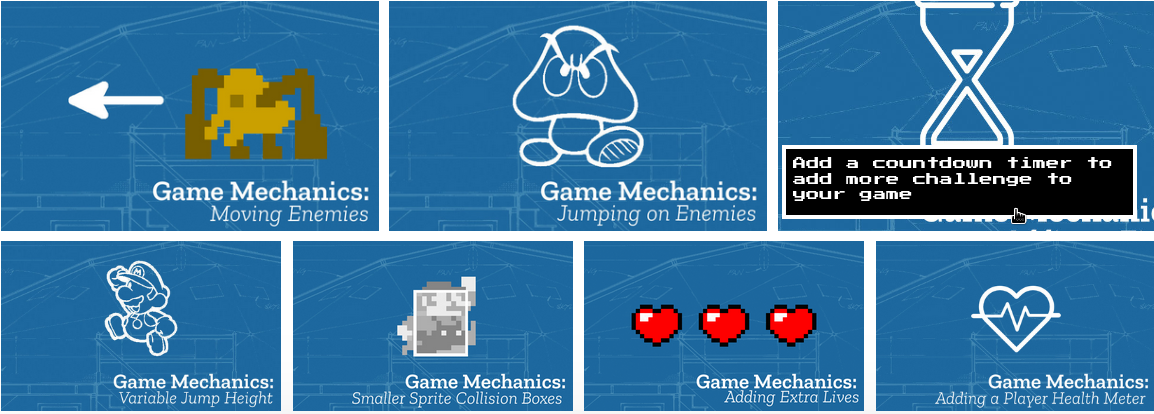
Figure: A screenshot of the hub of GDPs pointing to code snippets and instructional chapters
The REEPPP pedagogical framework
Gameplay Design Patterns formed an important part of my second major pedagogical contribution: the REEPPP (Remix-Enabled, Elective, Progressive, Pattern-Patching) pedagogy.
Although REEPPP emerged through the PhD, it also built upon ideas I had been exploring for many years. My earlier work with Mozilla’s Teach the Web initiative had centred on remixable web projects, browser-based coding environments and openly licensed educational resources. REEPPP extends these ideas beyond remixing alone. Gameplay Design Patterns provide a shared conceptual language, while the wider framework connects remixing, progression, and collaborative participation into a coherent pedagogy.
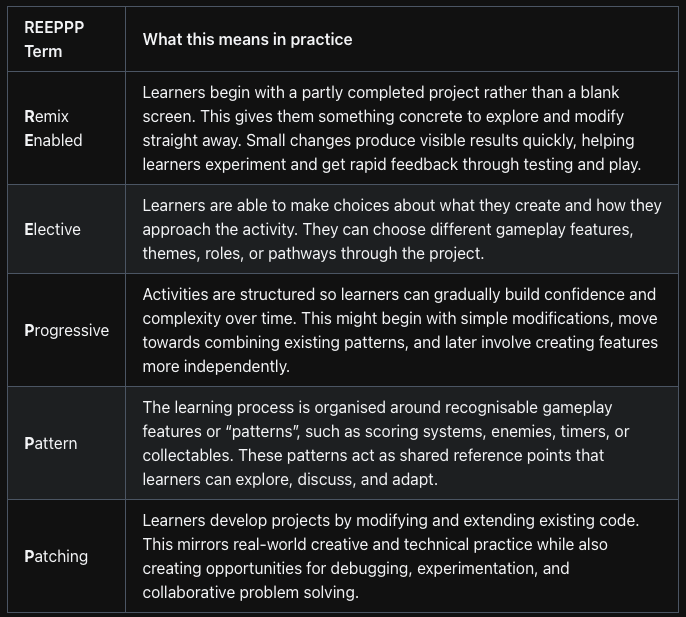
Table: The five interconnected elements of the REEPPP pedagogy
There are many interconnected elements within the REEPPP pedagogy. We have already explored the role of Gameplay Design Patterns and the choices they offered learners, so I will now turn to two other important aspects of the framework: remixing and patching.
Remixing involved beginning with a functioning (albeit half-baked) game (in this case a platform game), thus reducing the intimidation of starting with a blank slate and immediately situating learners within a familiar context. Small modifications produced rapid visual feedback, encouraging experimentation and helping participants connect code changes with gameplay outcomes. Working from a shared template also created common technical foundations, making it easier for participants to share ideas, compare games and support one another. As projects evolved, remixing became a natural route into collaboration, with learners adapting each other’s ideas and gradually developing confidence to make increasingly substantial changes of their own.
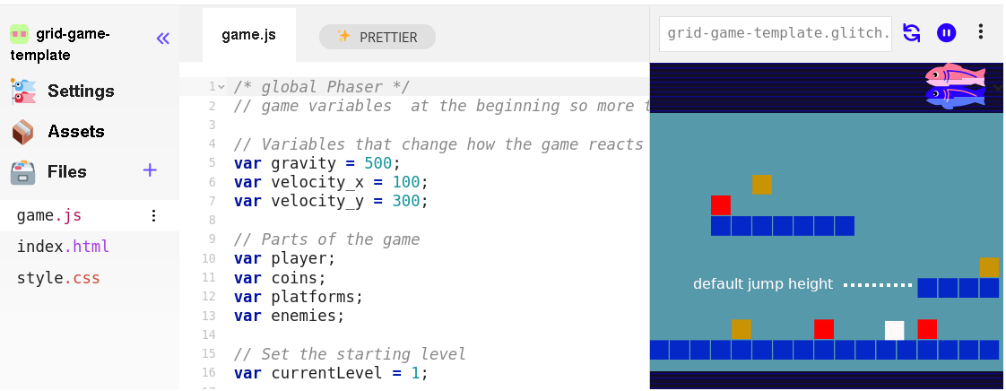
Figure: Simple game template - with limitation of initial jump height shown
Patching extended the idea of remixing from whole projects to individual gameplay features and code fragments. Learners regularly copied, adapted and combined snippets of code to introduce new mechanics into their games. Participants learnt by asking questions, observing others, sharing discoveries, debugging together and helping each other integrate new ideas into their projects. Mistakes became opportunities for experimentation and discussion, often sparking conversations that spread coding techniques and gameplay ideas throughout the group. To reflect the value of errors, for one iteration we called our group the Glitchers Game Club. Over time, knowledge became distributed across participants, gameplay patterns, documentation and shared practice, creating a collaborative learning environment in which everyone had the potential to contribute to and benefit from the community’s growing collection of repertoires.
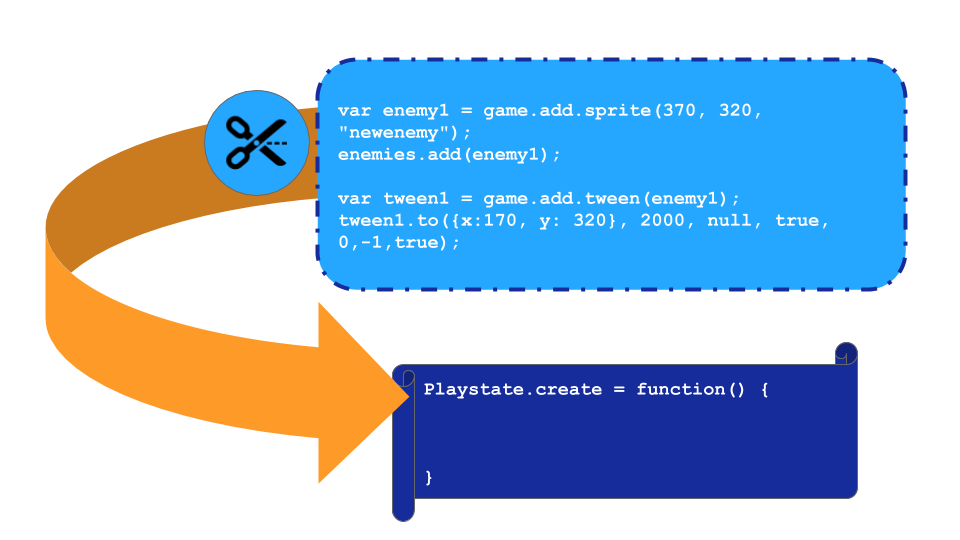
Figure: An example of a resource to support Pattern Patching
Making the pedagogy concrete: the facilitator toolkit
One of the design principles throughout the PhD was that the pedagogical ideas should remain practical. Rather than existing only as a framework described in the thesis, REEPPP became embodied in a growing collection of openly licensed resources that facilitators could use, adapt and extend within their own settings.
Over the course of the research, these resources developed into a facilitator toolkit designed to support open-ended, collaborative game development while reducing many of the practical challenges associated with running creative coding workshops.
As the later stages of the data analysis progressed, I interpreted the resources as a way to support the development of relational agency: creating opportunities for learners to build on one another’s ideas, share expertise, solve problems together and develop collective repertoires of practice. The toolkit is also intended to help facilitators connect with learners’ existing interests beyond the workshop. Participants regularly brought ideas from the games they played at home, online communities, YouTube videos and conversations with friends into the sessions. By providing flexible resources and multiple pathways through activities, the toolkit sought to harness these existing funds of knowledge, echoing Mimi Ito’s work on connected learning and the educational value of young people’s wider gaming and metagaming (additional cultural activities related to gaming) practices.
The toolkit includes:
Gameplay Design Pattern collections combining tutorials, code snippets and worked examples that learners can access when they need them.
Half-baked game templates providing just enough structure to get started.
Quick Start Cards to help participants rapidly begin creating games.
Side Missions offering optional challenges that encourage experimentation, extension, and diverse forms of participation.
Facilitator guidance describing practical ways of organising sessions, playtesting, encouraging collaboration and supporting learner agency.
A particularly encouraging outcome of the research was that the toolkit proved transferable across different programming environments. Early design cycles used Phaser.js with JavaScript, allowing participants to work directly with professional web technologies. Later cycles adopted Microsoft MakeCode Arcade, whose block-based interface lowered the barrier to entry while still allowing learners to transition to JavaScript. Although these environments differ considerably, the underlying pedagogy remained remarkably consistent, suggesting that REEPPP is not tied to a particular language or platform.
Separate versions of the toolkit are therefore available for both programming environments:
Phaser Toolkit – https://3m-phaser.jammlabs.org.uk/ – supporting text-based game development using JavaScript and the Phaser framework.
MakeCode Toolkit – https://3m-makecode.jammlabs.org.uk/ – supporting both block-based programming and the transition to JavaScript using Microsoft MakeCode Arcade.
All of the resources have been published as Open Educational Resources (OERs). Facilitators are encouraged not only to use them, but also to adapt, extend and republish them within their own communities. The complete facilitator toolkit, together with implementation guidance and links to all supporting resources, is available at: http://pump.jammlabs.org.uk/tech_appendix/toolkit/