Back to All Events

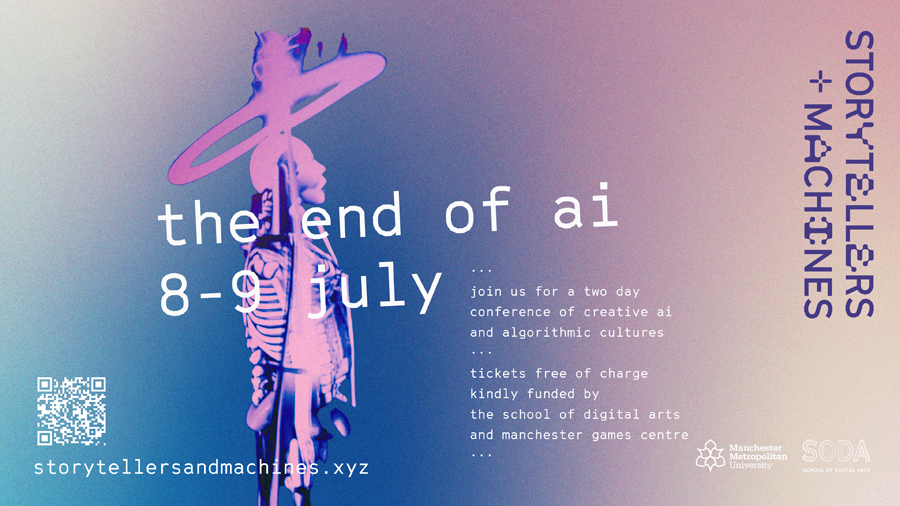
Storytellers and Machines 2026: The End of AI


Conference dates 8-9 July 2026

Submission deadline 1 April 2026

The Storytellers + Machines 2026 conference on creative A.I. and AI cultures returns to SODA and Manchester School of Art. Since 2023, the event series has led debate on the use of A.I. in arts and culture, focusing on artistic practice and the creative industries. Now, as an artistic and academic community, we speculate, imagine, and perhaps plot the end of A.I. and wonder what might follow.

 Over two days, keynotes, paper presentations, exhibited works, and evening performances will give conference attendees an opportunity to explore, champion and challenge the use of A.I. in creative settings. Panels will present and discuss concerns about the impact of A.I. on media producers and their audiences in disciplines such as games, music and film. The event will prompt us to imagine what a post-A.I. cultural and creative sector might look like — and will conclude with debate and a symbolic vote on whether to save or end creative A.I.

Storytellers + Machines 2026 is organised by the SODA Speculative Technologies Group in collaboration with Manchester Games Centre.
Theme: THE END OF A.I.

Suggested interpretations

(LOSS OF) ZEITGEIST
As generative technology begins to find its place in the digital ecosystem, will it become indistinct as a phenomenon? How does cultural production change as A.I. becomes an unremarkable part of our creative lives?

Examples

  • Practitioner presentations on how their work has adapted to A.I. usage

  • Studies on types of A.I. in creative industries and its impact

  • Critical discussion of societal and cultural changes caused by A.I. normalisation / changing notions of creative producer

ECOLOGICAL BURNOUT
Increasingly, A.I. infrastructure contributes to ecological crises. Will creative A.I. in its current form become unsustainable or unacceptable as a practice? How else should we navigate the harms of algorithmic production?

Examples

  • Utopian/dystopian ecological imaginaries/worlds

  • Studies on the ecological impact of A.I.

  • Sustainable models of generation, algorithmic reparations and mitigations

ARTISTIC LIMITS
Mass adoption of creative A.I. seems to be related to automation and efficiency, rather than new types of art and culture. Are we discovering artistic limits to generative tools? And what emerging forms of experience and interaction in the arts are being made possible by these new technologies?

Examples

  • Artistic works, technological innovations, and performances that challenge the limits of A.I. technology

  • Reviews/critical discussions of A.I. artworks and artists

  • The possible role of post-AI technologies, such as quantum computing, in artistic contexts

COMMUNITY REJECTION
Many practitioners see little to gain but much to lose from the market rollout of creative A.I. tools and reject them as a way of working. Should we fantasise (murderously) about a future without it, learn to love it, or find a third way?

Examples

  • Artistic visions of the end of A.I., its symbolic death

  • Analogue and procedural artistic responses to generative technology

  • Studies on community responses to A.I. technology

  • Activist and community rejection case studies 

What we are looking for

We will accept proposals for:

  • 15-minute presentations - paper presentations and talks from both academics and creative practitioners, followed by chaired panel discussions.

  • Presented artworks and performances – artists and performers are invited to showcase their works.

  • Technical demonstrations - demos presenting academic and industry research are welcome.

  • Creative workshops – a small number of workshops will be accepted.

Who we are looking for

We aim to provide a lively space for critical debate, generous appreciation, and networking for:

  • Academics and independent researchers*

  • Artists and performers

  • Industry practitioners

 *Postgraduate students are welcome to apply!

The organising team is committed to equity and inclusion. Practically, this means providing application support and guidance for first-time conference submissions and giving equal weight to artist, industry, and academic submissions when considering the work you submit.

More details on submissions

Please feel free to suggest other ideas or get in touch via aistorytelling@mmu.ac.uk if you have a proposal and want to discuss it with organisers.

Deadline: 1st April 2026