AI, Sustainability, and the Future of Game Development: New Report from Manchester Game Centre Researchers
Artificial intelligence is transforming game development — but its environmental and social impacts are still poorly understood. A new report authored by Manchester Game Centre researcher Dr Chloé Germaine, in collaboration with international partners in the STRATEGIES Horizon project, now offers one of the clearest and most comprehensive examinations of the relationship between AI and sustainability in the games industry to date.
Why this report matters
The global conversation around AI is dominated by hype, speculation, and promises of efficiency. But beneath the excitement lie serious questions about the material realities of AI systems: their energy demands, carbon emissions, water usage, labour practices, and the infrastructural growth required to support them. As the report shows, these impacts are far from abstract — they are immediate, measurable, and deeply entangled with issues of climate justice.
For game development, these questions take on particular relevance. Games are computationally intensive products built on complex global supply chains. The addition of high‑impact AI tools has the potential to intensify existing sustainability issues and introduce new ones.
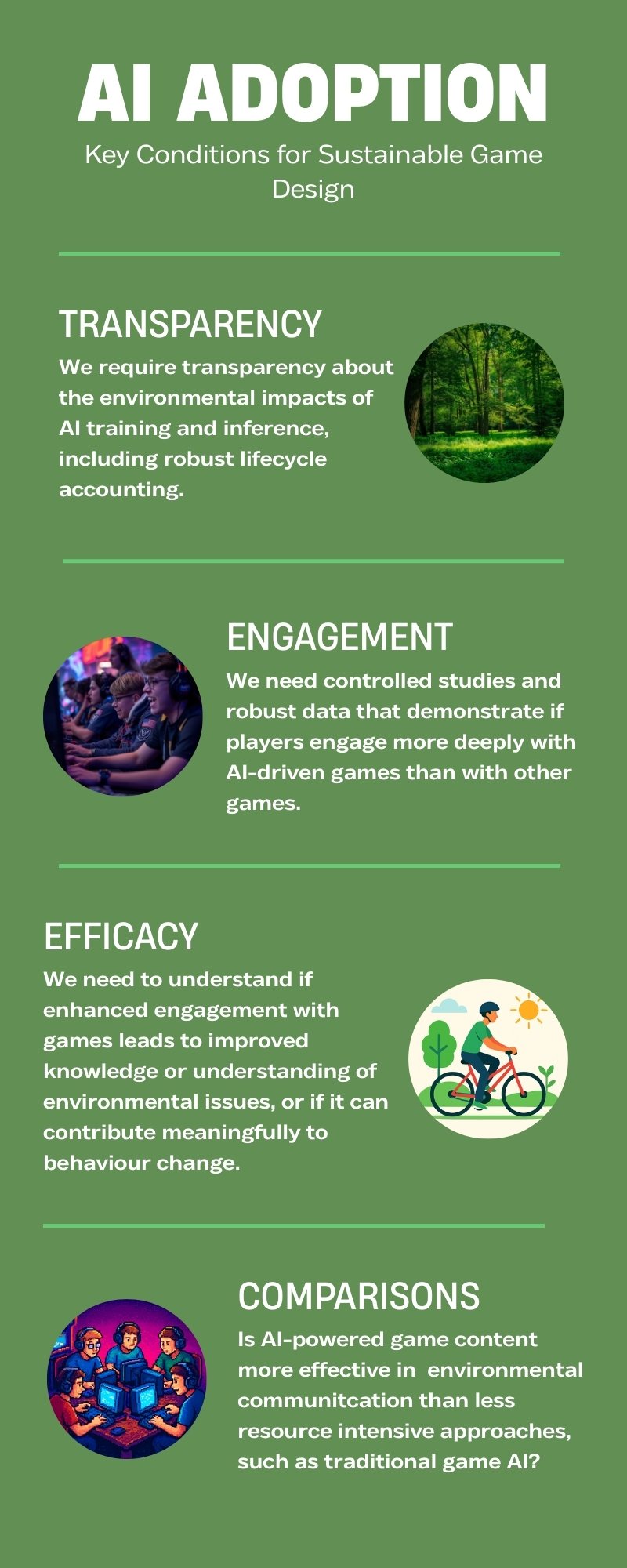
What the report reveals
The report provides:
A clear taxonomy of AI in games, distinguishing low‑impact traditional game AI from highly energy‑intensive generative models.
A synthesis of current research on data centres, compute demand, carbon emissions, and water consumption.
A critical account of AI hype, corporate opacity, and the challenges of environmental measurement.
Guidance for developers seeking to make responsible, evidence‑based decisions.
A wider analysis of climate‑justice impacts, from e‑waste to extractive labour practices.
This work builds on Manchester Game Centre’s commitment to examining game development in its full material, cultural and political contexts. It recognises that sustainability in games cannot be achieved through technological optimism alone — it requires structural understanding, critical literacy, and transparent decision‑making.
A role for critical game research
As the report argues, developers need the tools to evaluate AI systems not only in terms of their creative potential but also their ecological footprint. The Game Centre’s researchers highlight the need for clear governance frameworks, improved reporting standards, and sector‑wide collaboration to support truly sustainable innovation.
This publication strengthens the Game Centre’s leadership in sustainability research and offers vital insights for studios, educators, policymakers and students navigating the rapidly evolving AI landscape.