WElcome to Rituals of Play
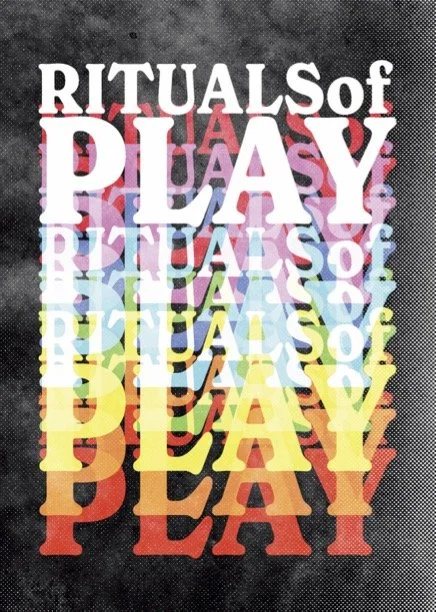
Cover art and logo by Isa Alsaba. Additional images and Layout by Kevin Craig

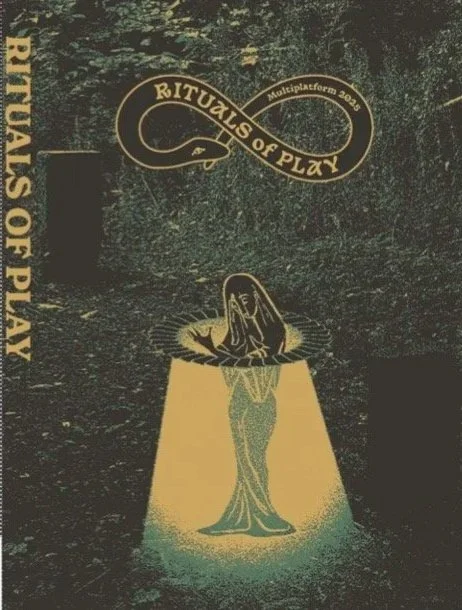
Rituals of Play, published by the Manchester Game Centre and DVRK, gathers seventeen pieces from writers, designers, artists, and practitioners who work at the threshold of games and the occult. Their work explores games as magical practice, and magic as a form of play. The zine gathers material from the Multiplatform event in 2025 (and beyond). Scholarly essays sit alongside working rituals, grimoires, games, and visual and sonic experiments, with no firm line drawn between studying (or practicing) the occult, and playing games.
Inside, Jeff Howard traces the lusory attitude running through magical practice; Leah Lockhart follows solo TTRPGs into chaos magic and servitor work; Annika Olofsdotter Bergström and Rebeca Yates offer a ritual for becoming-moon; Ingmar Vogelsang retells Hanover's history through the Cthulhu Mythos; and Andrej Kapcar asks what esoteric knowledge lurks behind the screen of modern horror games. Alongside these essays there are boardgaming rituals, alchemical horrors, botanical grimoires, and other pieces that treat the game table, the magick circle, and the liminal space between as one and the same territory.
The full zine is free to read and download as a PDF.
The contributors
Rituals of Play brings together scholars, game designers, artists, magical practitioners, and people who are several of those at once. All contributors retain copyright of their work.
Isa Alsaba is a Bahraini artist based in Manchester whose work spans painting, programming, and poetry, shaped by a long-held obsession with occulture and spiritual experience and how they interweave with her creative practice. She holds an MA in Games Art, through which she explores how shaders can render painterly aesthetics in games. She designed the graphics for Multiplatform 2025: Rituals of Play and is currently developing a playable demo of Folly of the New Age.
Wei Ting Chia is an artist-researcher with an illustration and game design practice. Her work spans video games, board games, comics, and exhibitions, exploring themes of isolation, connection, and cultural displacement through post-apocalyptic narratives. Through her practice-based approach, Wei Ting investigates how visual storytelling and game mechanics can examine contemporary life. Her projects engage with questions about individual agency, finding community, and the future of humanity. She strives to create works that allow us to imagine our social realities differently.
Kin Chui is an artist and indie game developer with a foundation in film. Their practice tends to ponder the role of spirit in the tension and entanglement between digital technologies and the organic, and has recently been curious about the possibilities of solidarity and play. As part of an ongoing interest and research into games as a tool for imagining futures, Kin Chui welcomes contact from any player open to sharing their imagined future with them. Please email your responses to fuzzyrenders@gmail.com.
Philipp Doebler (he/him) has been playing tabletop roleplaying games since the 90s, often in the role of facilitator, encouraging collaborative storytelling. His mainstays in play and design are smaller, rules-lite, narrative games; recent titles include Deepwater Enclaves, a futuristic post-apocalyptic underwater exploration game, and Remote Observer, a solo cyberpunk game about a watchful AI. A former editor of the Conjured Games co-op's Conjurations zine, he works in academia at the intersection of quantitative methods, education, and psychology.
Lisa Farrell is a postgraduate researcher at Anglia Ruskin University, exploring digital-inspired interactivity in analogue fiction and writing a speculative branching novel. Her research was partly inspired by her freelance work writing RPG adventures and Twine fiction in the hobby games industry, and she has contributed to tabletop RPGs including Twilight Imperium and Warhammer 40,000: Imperium Maledictum. Her original fiction has been published by Mslexia, Litro, and the British Fantasy Society, and performed by Liars' League London.
James "Pigeon" Fielder is an instructor of political science at Colorado State University and professor of theology and religious history at Cherry Hill Seminary. He researches emergent political behaviour in tabletop, live-action, and digital games, and the politics of science fiction and fantasy literature. He is a Fellow of the German Wargaming Center, managing editor of Active Learning in Political Science, associate editor of Simulation & Gaming, and a TEDx speaker on games.
Jeff Howard is Associate Professor of Games and Occulture at Falmouth University and the author of Quests: Design, Theory, and History in Games and Narratives and Game Magic: A Designer's Guide to Magic Systems in Theory and Practice. He has presented on occulture at international conferences including Berlin Occulture, Trans-States, and ESSWE9, and studies sabbatic practices at the intersection of the Left Hand Path and the Typhonian current. Through scholarship and creative work, he champions play as a transformative and transcendent practice.
Yami Kurae is an artistic project by MGC member Matteo Polato and Jacopo Bortolussi. It began around fifteen years ago as a noise and radical improvisation music duo, with a strong focus on the reuse of obsolete and malfunctioning media and on how low fidelity can convey atmosphere, imagination, and lore. It has since evolved into composing music for film and theatre, including the score for the multimedia Noh theatre version of Ghost in the Shell (dir. Shutaro Oku, premiered 2020 at Setagaya Theatre, Tokyo).
Leah Lockhart is a freelance facilitator, zinester, and co-owner of fractals, a worker-owned cooperative based in Glasgow specialising in learning and evaluation, workshop design and facilitation, and games design. As a facilitator, she combines game mechanics with anti-oppressive facilitation approaches to provide structures for conversation and reflection that are creative and accessible. She is a proud member of her local zine library's TTRPG group and a dedicated dog mum.
Kianush Monschau (he/him) began his roleplaying journey in the 2010s as the forever GM of his friend group, and his interests have since broadened to include many systems as well as board and wargames. He enjoys reading TTRPG manuals, particularly those with extensive lore sections, and is fascinated by their art, layout, and information design — sometimes to the detriment of his knowledge of the actual rules. Bleeding Zeal is his first "published" game. He studies and works in academia, somewhere between psychology, history, and philosophy.
Brigid Nemeton is a blacksmith, winemaker, game designer, and recovering chaos magician based in the Pacific Northwest. Her interest in game design rests with its relationship to ritual, its potential for creating meaningful experiences outside the normal lives of its participants, and random tables. Her interest in the esoteric springs from a childhood fascination with myth and folklore into an adult fascination with the intentional creation and manipulation of systems of meaning. Her favourite Victor Benjamin Neuburg poem is ‘The Triumph of Pan.’
Annika Olofsdotter Bergström is a senior lecturer and design researcher at Södertörn University in Stockholm, working at the intersection of feminist technoscience and participatory (game) design. Her work explores how citizen engagement and playful interventions can transform everyday public spaces into sites of democratic practice and collective imagination. She has contributed to projects in speculative design and public participation, developing methods that invite communities to reimagine public spaces as arenas for agency and social change.
Máté Szilassi (he/him) is a miniature collector and painter drawn to gritty aesthetics, cults, dark gods, folk horror, nasty mutants, and the generally grotesque — settings where everything feels stuffy, doomed, or slightly on the brink of collapse. Mostly a boardgamer and skirmish wargamer, he makes his first foray into roleplaying game design with Bleeding Zeal. In his academic work in psychology, he studies disgust, morbid curiosity, and moral psychology, asking why people are drawn to disturbing material and what that reveals about how we relate to harm, violence, and each other.
Karin Valis is a Berlin-based machine learning engineer and writer with a deep passion for everything occult and weird, focused on finding conceptual resonances between the latest machine learning technology and the esoteric. She writes Mercurial Minutes, hosts monthly meetings of the online coven Gnostic Technology, and is the AI architect behind Palinode Productions' Khora algorithm. She has built occult algorithm prototypes, co-founded a fake startup, and designed a tarot deck. Her contribution to this issue began as a keynote at Multiplatform 2025.
Ingmar Vogelsang is an executive at the Sustainability Bureau of the City of Hanover — the city whose history his contribution to this issue retells — where he uses games as an opener to promote more sustainable habits. He edited the first German fair-trade murder mystery game and, within the cooperation Hannover lernt spielen(d) ("Hanover learns (by) playing"), co-organised a 2023 convention on gender and sustainability in analogue gaming. He has played RPGs and tabletop games for more than thirty-five years and board games even longer.
Chloé Wake is co-director of the Manchester Game Centre and a Reader in Environmental Humanities at Manchester Metropolitan University. Her research is located at the crossroads of game studies, environmental humanities, and the Gothic, with long-standing preoccupations in weird, eco-horror, analogue game design, and the strange agencies of matter at play. A LARPer since 2004, she designs and writes roleplaying games and makes indie games under the Frank and Alex Games imprint.
Rebecca Yates works with dance and choreography, and is the artistic curator of Dans i Blekinge and the Brådjupa Blekinge Dance Festival in Blekinge, Sweden. She holds a BA (Hons) from London Contemporary Dance School and an MA in Choreography from SKH, Stockholm. Since completing her master's, she has developed a practice uniting pedagogical and choreographic processes, one that considers didactic and artistic approaches and has proven transferable across contexts. Her recent artistic activity has centred on cares for the becoming of dance through choreographic, bodily, and situated phenomena.
Feedback Form
Thank you for taking a moment to reflect with us. Rituals of Play explores the points where play becomes ritualistic, and where ritual takes on a playful, experimental edge. This zine traces those overlaps where gestures, repetitions, disruptions, and small inventions start to feel like practices in their own right.
Your reflections help us understand how these ideas travelled: what caught your attention, what felt unfamiliar or suggestive, and what directions might be worth pursuing further.
This form is brief and open‑ended. You can respond analytically, speculatively, creatively, or minimally. We’re interested in the impressions that linger, however faint or fragmentary.
Thank you for contributing to this evolving inquiry.

Ethics Statement: How We Handle Your Data
We value your privacy and your trust. This feedback form does not collect, store, or use any personal data beyond the responses you choose to share. We do not require you to share names, emails, or identifying information, and we do not track or retain IP addresses. Your feedback is anonymous, voluntary, and used only to help us understand how people engaged with the Rituals of Play zine. Once you submit your responses, they are viewed in aggregate and are not stored in any way that could identify you. If you would like to receive occasional updates about the project, you may choose to share your email address. This is entirely optional. Any email you provide will be stored securely, used only for contacting you about this project, and will never be shared with anyone else. You can request to have your email removed at any time, in line with GDPR principles.
For further information, contact Chloe.Wake@mmu.ac.uk
Thank you for contributing your thoughts in a safe, respectful, and privacy‑respecting space.