Game Hacking as Critical Practice: New Report from Manchester Game Centre Researchers
What happens when we treat games not as finished products, but as systems to be questioned, dismantled, and remade? A new STRATEGIES report authored by Dr Chloé Germaine and Dr Paul Wake explores game hacking as a powerful pedagogical method for developing critical literacy, sustainability awareness, and design competence.
What is game hacking?
Hacking, in this research context, does not mean modding or adding surface‑level novelty. Instead, it involves transforming existing games to reveal and challenge the assumptions embedded in their rules, aesthetics, mechanics, and narratives.
By hacking games, students learn to:
Identify dominant logics such as extraction, competition and growth.
Experiment with alternative systems that foreground cooperation, care, circularity and degrowth.
Engage critically with the cultural and environmental implications of play.
Why hacking matters for sustainability
Hacking is uniquely positioned within a sustainability framework because it encourages:
Re‑use and repurposing of existing games and materials.
Reflection on the environmental impact of production, consumption and waste.
Systems thinking, as students analyse how games model real‑world social and ecological systems.
Low‑resource creativity, avoiding the need for new materials or energy‑intensive production.
The report includes rich case studies from university modules, research workshops, public events and international collaborations, demonstrating hacking’s versatility and pedagogical value.
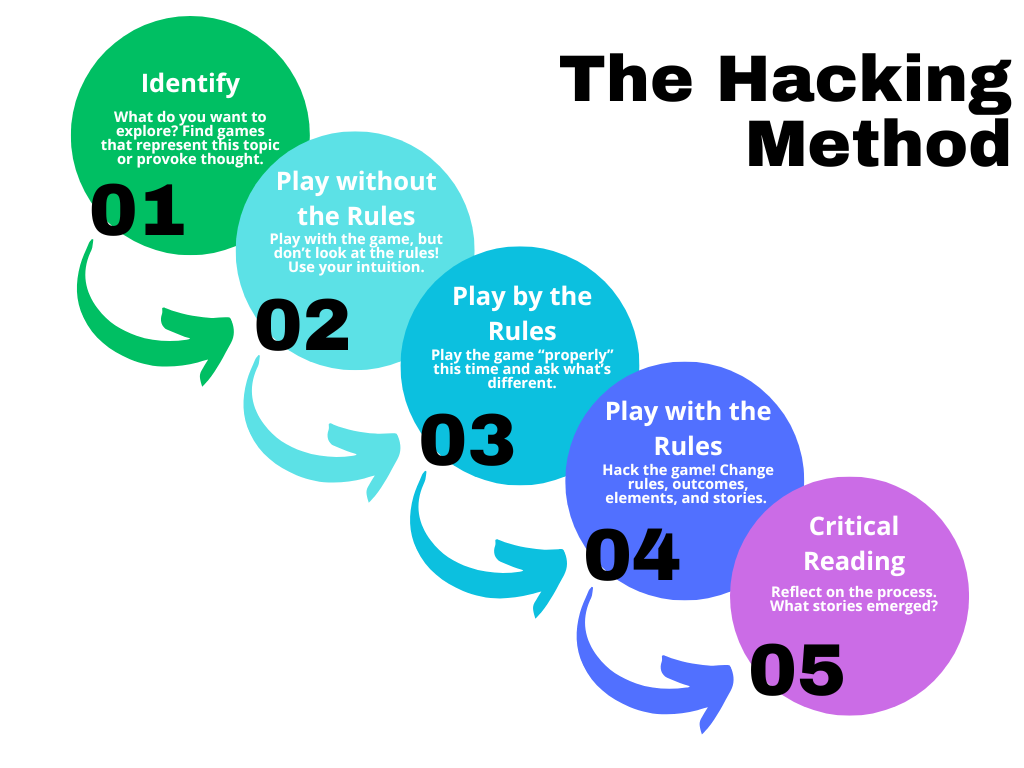
A Manchester approach to critical game design
This report builds on years of teaching and research at the Manchester Game Centre, where hacking has been used to engage students in creative inquiry, critical thinking, sustainability education and collaborative learning. The Centre’s work shows how game hacking can foster empowered, reflective designers with the skills to challenge dominant narratives and imagine alternative futures.
Alongside practical frameworks, the report provides guidance on safeguarding, inclusivity, accessibility, and ethical practice, ensuring that hacking activities remain safe, respectful and equitable.