CfP: Multiplatform 2027. History and Games
17–18 June 2027, Manchester Metropolitan University
Multiplatform is the annual Manchester Game Centre symposium dedicated to analogue and digital game studies and practice. In 2027, we turn to the theme of history and games, exploring the uses of history within games, the role that games can play in engaging with and interrogating the past, and the history of games themselves.
The twenty-first century has witnessed a remarkable development in the study of historical games. To encapsulate the diversity of approaches to this theme, already in 2017 Chapman, Foka, and Westin proposed an inclusive definition of historical game studies as: “the study of games that in some way represent the past or related to discourses about it, the potential applications of such games to different domains of activity and knowledge, and the practices, motivations and interpretations of players of these games and other stakeholders involved in their production and consumption.” Adjacent to and often overlapping with historical game studies, “archaeogaming” provides further elements to this discussion. As well as looking at the representation of the past in games, studies in archaeogaming have applied archaeological methodologies to games to study and preserve their culture, their design, and the ways that players engage with them.
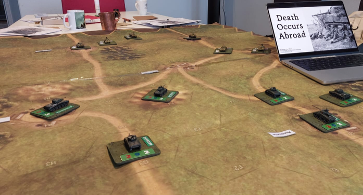
Death Occurs Abroad (Paul Wake)
Keynote lectures will be delivered by Dr Robert Houghton (University of Winchester) and Dr Florence Smith Nicholls (IT University of Copenhagen). Multiplatform 2027 will include an in-person analogue game jam/workshop, as well as a playable installation of Death Occurs Abroad, a World War Two game about the bureaucracy of death, designed by Prof. Paul Wake (Manchester Metropolitan University). Outputs and documentation from the symposium and jam will inform an online exhibition on the Manchester Game Centre website and itch.io page.
We invite proposals for contributions to Multiplatform that address historical game studies (in its broadest sense), exploring current trends and developments in this field, including (but are not limited to) the following themes:
The game form: What are the possibilities, uses, and limitations of the game form (analogue or digital) for the representation of historical topics and themes (whether periods, events, places, or people/individuals)?
Games, history, and the public: How can games be used to engage diverse audiences with historical topics? What is the relationship between cultural/collective memory and games?
Games as historic objects: How are games preserved (analogue or digital; archiving; recreation, etc.), and what difficulties are involved in working with games as historic objects?
Histories of games: In what ways do fans/fan-cultures contribute to the development of game histories? How can game play experience be preserved?
Submissions can be submitted for the following formats:
Individual papers (20 minutes + Q&A)
Research-creation / practice-based presentations (talk + demonstration; or critical reflection on making)
Creative submissions (e.g., playable works, digital or analogue)
Posters (to be displayed as A0 printed posters)
Roundtables / panels (60–90 minutes; 3–5 participants recommended)
We welcome proposals from scholars, game designers, archivists, librarians, and independent creators, as well as collaborative teams.
Submission guidelines
Title + abstract (c. 200–300 words) describing the contribution, materials/works discussed or presented, and format.
Short bio (c. 100 words) and affiliation (if any).
For creative/playable work, include a brief technical note (platform, access needs, install requirements) and, where possible, a link to documentation or a build-in-progress.
Submission email: j.cromwell@mmu.ac.uk / Please put ‘MULTIPLATFORM’ in your subject line.
Deadline: 31 January 2027
Notification of decisions: 1 March 2027